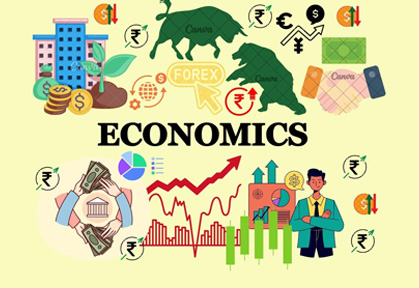
B.Ed in Economics
The B.Ed in Economics course is designed to prepare student-teachers to teach
Economics effectively at the secondary and higher secondary levels. The
course emphasizes understanding economic concepts, analytical thinking,
real-world applications, lesson planning, and the use of innovative and
technology-enabled teaching methods.
Course Objectives
- To prepare individuals to teach Economics at
the school level.
- To understand basic economic concepts and
theories.
- To develop analytical and decision-making
skills in Economics.
- To apply learner-centered and inquiry-based
approaches in teaching Economics.
UNIT – I : Aims and Objectives of Teaching Economics
- Economics – Meaning, Nature, Scope, Need and
Significance.
- Values, Aims and Objectives of Teaching
Economics in Schools.
- Instructional Objectives and Behavioural
Objectives in Economics.
- Need and Importance of Instructional
Objectives.
- Bloom’s Taxonomy – Cognitive, Affective and
Psychomotor Domains.
- Revised Bloom’s Taxonomy (2001 – Anderson &
Krathwohl).
UNIT – II : Teaching Skills
- Micro-Teaching – Concept, Definition, Steps
and Cycle.
- Micro-Teaching versus Macro-Teaching.
- Skill of Set Induction.
- Skill of Explaining and Skill of
Questioning.
- Skill of Stimulus Variation and
Reinforcement.
- Skill of Non-verbal Clues and Skill of
Closure.
- Link Lesson and Model Episode.
UNIT – III : Approaches of Teaching
- Approaches of Lesson Planning and its Steps.
- Organizing Teaching at Memory Level –
Herbartian Model.
- Organizing Teaching at Understanding Level –
Morrison Teaching Model.
- Organizing Teaching at Reflective Level –
Bigge and Hunt Teaching Model.
- Unit Plan and Lesson Plan Writing.
UNIT – IV : Methods of Teaching
- Teacher-Centered Instruction – Lecture
Method.
- Demonstration Method and Discussion Method.
- Learner-Centered Instruction – Self
Learning.
- Inquiry Method and Problem-Solving Method.
- Project Method and Activity Based Learning
(ABL).
- Case Study Method, Debate and Seminar
Method.
- Active Learning Method (ALM) and Advanced
Active Learning Method (AALM).
UNIT – V : Instructional Media
- Classification of Instructional Media in
Economics.
- Use of Charts, Graphs, Diagrams and
Statistical Tables.
- Use of Mass Media in Classroom Instruction.
- Tele-Conferencing and Communication
Satellites.
- Computer Networking, Economic Software and
Digital Resources.
- Blended Learning, Flipped Classroom,
Artificial Intelligence and Augmented Reality.
Curriculum Includes
- Micro Economics and Macro Economics.
- Indian Economy and Development Economics.
- Statistics and Quantitative Techniques.
- Pedagogy of Economics.
- Economic Surveys, Projects and Case Studies.
Join Us Today!
Become a competent Economics teacher capable of guiding students to
understand economic issues, policies, and decision-making in real-life
contexts.
Enroll now.